
From Reactive Monitoring
to Predictive Analytics in Banking
Built a real-time activity intelligence platform providing end-to-end visibility across infrastructure,
applications, and business operations within a complex banking ecosystem.
applications, and business operations within a complex banking ecosystem.
The Client
A large international banking group providing comprehensive retail and corporate financial services across multiple markets. The organisation operates an extensive network of branches, digital channels, and multichannel customer touchpoints, supported by complex core banking systems and distributed technology platforms.
Its service portfolio includes personal and business banking, lending, payments, treasury services, and investment solutions for individuals, SMEs, and large enterprises. With millions of customers and a substantial operational footprint, the institution manages high transaction volumes across a broad ecosystem of interconnected systems and channels.
Its service portfolio includes personal and business banking, lending, payments, treasury services, and investment solutions for individuals, SMEs, and large enterprises. With millions of customers and a substantial operational footprint, the institution manages high transaction volumes across a broad ecosystem of interconnected systems and channels.
4
0
9
4
3
7
8
6
4
1
0
4
3
2
7
8
0
4
2
0
M
4
3
2
7
8
0
4
2
0
+
Customers across retail and corporate banking segments
4
0
9
4
3
7
8
6
4
1
0
4
3
2
7
8
0
4
2
0
0
4
3
2
7
8
0
4
2
0
0
4
3
2
7
8
0
4
2
0
M
Branches and digital channels globally
4
0
9
4
3
7
8
6
4
1
5
4
3
2
7
8
0
4
2
0
4
0
9
4
3
7
8
6
4
0
4
0
9
4
3
7
8
6
4
0
4
0
9
4
3
7
8
6
4
0
+
Employees supporting global banking operations


The Challenge
The bank operated a highly distributed technology landscape composed of infrastructure components, application platforms, and business systems generating large volumes of operational data daily. Monitoring processes were largely manual, reactive, and updated periodically, limiting the ability to detect issues early or obtain a consolidated view of system behaviour across layers.
Operational visibility was fragmented. Infrastructure metrics, application logs, and business activity were analysed in isolation, preventing correlation across systems and channels. This made it difficult to identify root causes of incidents, anticipate service degradation, or understand how technical issues were impacting customer operations and branch performance.
The institution needed to evolve from reactive monitoring to a near real-time, multi-layer activity intelligence capability—integrating infrastructure, application, and business signals to enable proactive incident management, operational optimisation, and predictive insight across its multichannel banking ecosystem.
Operational visibility was fragmented. Infrastructure metrics, application logs, and business activity were analysed in isolation, preventing correlation across systems and channels. This made it difficult to identify root causes of incidents, anticipate service degradation, or understand how technical issues were impacting customer operations and branch performance.
The institution needed to evolve from reactive monitoring to a near real-time, multi-layer activity intelligence capability—integrating infrastructure, application, and business signals to enable proactive incident management, operational optimisation, and predictive insight across its multichannel banking ecosystem.
Our Solution
Designed and implemented a production-grade Big Data architecture based on Hadoop, Apache Spark, and MongoDB, enabling real-time monitoring and predictive analytics across infrastructure, application, and business domains within the bank’s multichannel ecosystem.
The architecture unified ingestion from heterogeneous sources spanning business channels (branches, internet, ATMs, mobile), enterprise applications, authentication and transactional systems, and infrastructure layers (hosts, virtualisation, and network components). Structured and semi-structured data—including system metrics, application logs, operational events, and user activity—were consolidated into a distributed storage and processing framework capable of handling high-volume, multi-format inputs.
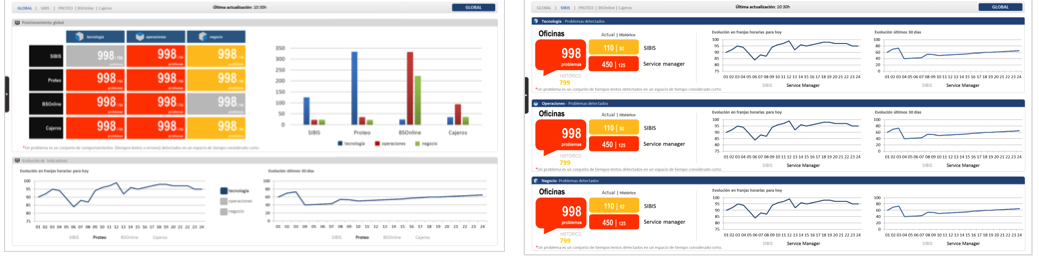
The platform combined real-time, near real-time, and historical processing layers to correlate events across systems and monitoring levels (infrastructure, application, and business). This multi-layer integration enabled cross-domain observability, root-cause identification, proactive incident management, and the progressive introduction of predictive models to anticipate technical and operational events—evolving monitoring from reactive analysis to intelligent operational management.
The architecture unified ingestion from heterogeneous sources spanning business channels (branches, internet, ATMs, mobile), enterprise applications, authentication and transactional systems, and infrastructure layers (hosts, virtualisation, and network components). Structured and semi-structured data—including system metrics, application logs, operational events, and user activity—were consolidated into a distributed storage and processing framework capable of handling high-volume, multi-format inputs.
The platform combined real-time, near real-time, and historical processing layers to correlate events across systems and monitoring levels (infrastructure, application, and business). This multi-layer integration enabled cross-domain observability, root-cause identification, proactive incident management, and the progressive introduction of predictive models to anticipate technical and operational events—evolving monitoring from reactive analysis to intelligent operational management.
Multi-Layer Monitoring
Designed a unified monitoring framework spanning infrastructure, application, and business layers, enabling end-to-end observability across the bank’s multichannel ecosystem. The architecture correlated system metrics, logs, and operational events to eliminate siloed monitoring and provide a consolidated operational view.
Real-Time Processing
Implemented combined streaming and micro-batch processing pipelines to support real-time, near real-time, and historical analysis. This enabled rapid detection of anomalies, reduced latency in incident identification, and improved responsiveness across operational teams.
Data Integration at Scale
Integrated structured and semi-structured data from diverse sources including branches, internet banking, ATMs, mobile channels, authentication systems, and infrastructure components. The platform handled multi-format inputs at scale, consolidating distributed data into a unified analytical layer.
Geolocation Insights
Enabled geospatial analysis of multichannel operations to understand how customer activity, service performance, and operational incidents were distributed across branches and regions. This capability supported queue estimation, workload balancing, and targeted service optimisation based on real operational demand.
Proactive Incident Mngmnt
Enabled cross-layer event correlation to move from reactive alert handling to proactive incident management. The solution facilitated root-cause identification by linking infrastructure behaviour with application performance and business impact in a single monitoring framework.
Predictive Intelligence
Introduced predictive models to anticipate technical and operational events, including customer behaviour and service usage patterns. The platform evolved monitoring capabilities from descriptive and diagnostic analysis toward predictive decision support, improving operational planning and service optimisation.





The Value
The platform transformed monitoring from a reactive, manual process into an intelligent, near real-time operational management capability. By correlating infrastructure, application, and business signals within a unified Big Data framework, the bank achieved end-to-end visibility across its multichannel ecosystem and evolved toward proactive and predictive decision-making.

4
0
9
4
3
7
8
6
4
1
2
4
3
2
7
8
0
4
2
0
4
0
9
4
3
7
8
6
4
0
GB
4
3
2
7
8
0
4
2
0
+
Daily Data Ingested
Integrated high-volume, multi-format operational data across infrastructure, applications, and business systems.
4
0
9
4
3
7
8
6
4
1
B
4
3
2
7
8
0
4
2
0
+
Records Analysed Per Day
Correlated millions of cross-layer events daily to enable near real-time monitoring and observability.
4
0
9
4
3
7
8
6
4
8
5
4
3
2
7
8
0
4
2
0
%
Predicitive Accuracy
Delivered predictive models with up to 85% accuracy in selected operational and customer behaviour scenarios.
.svg)
Operational Resilience
Improved detection and resolution of incidents through cross-layer event correlation, reducing reliance on manual analysis and accelerating response times across IT and operations teams.

Service Optimisation
Enabled data-driven decisions on branch staffing, workload balancing, and service capacity through geolocation analytics and real-time operational visibility.
.svg)
Predictive Decision Support
Introduced predictive models for customer behaviour and operational events, allowing the organisation to anticipate demand patterns, optimise services, and enhance customer experience.

Talk Less. Build More.
© 2026 All rights reserved