
From Outsourced Reporting to an In-House Lloyd’s Regulatory Data Platform
Built a modern, domain-driven data platform for Lloyd’s regulatory reporting, replacing outsourced services and contributing to an estimated $1M in monthly savings
The Client
A publicly listed global (re)insurance group headquartered in the United States, operating across property, casualty, and specialty lines. The organisation underwrites complex risks for multinational corporations and institutional clients, with a strong presence across North America, Bermuda, Europe, and Asia.
As a large-scale international carrier operating within the Lloyd’s market, the company is subject to stringent regulatory and financial reporting requirements. Its global footprint, underwriting complexity, and capital management obligations demand high standards of governance, accuracy, and transparency across regulatory submissions.
As a large-scale international carrier operating within the Lloyd’s market, the company is subject to stringent regulatory and financial reporting requirements. Its global footprint, underwriting complexity, and capital management obligations demand high standards of governance, accuracy, and transparency across regulatory submissions.
4
0
9
4
3
7
8
6
4
$
18
4
3
2
7
8
0
4
2
0
B
4
3
2
7
8
0
4
2
0
+
Gross Writeen Premiums
4
0
9
4
3
7
8
6
4
3
0
4
3
2
7
8
0
4
2
0
0
4
3
2
7
8
0
4
2
0
0
4
3
2
7
8
0
4
2
0
+
Employees worldwide
4
0
9
4
3
7
8
6
4
10
0
4
3
2
7
8
0
4
2
0
+
Countries of operation

The Challenge
Regulatory reporting to the Lloyd’s market was historically outsourced to a third-party managing agency. While compliant, this operating model limited internal control, reduced transparency over calculation logic, and constrained the organisation’s ability to evolve reporting processes in line with business and regulatory change.
The reporting landscape itself was complex and high-volume. Lloyd’s submissions required the production of 44 distinct regulatory reports, each subject to frequent iteration and version control. The reporting logic incorporated approximately 10,000 business metrics and required strict adherence to 1,000 validation rules defined by Lloyd’s specifications. Ensuring consistency, traceability, and auditability across this scale of reporting posed a significant architectural and operational challenge.
The organisation needed to transition from a manually coordinated, externally managed process to a modern, automated, and internally governed data platform capable of industrialising regulatory production. The objective was not only to internalise reporting, but to design a scalable domain-driven architecture that could support future financial and regulatory use cases beyond Lloyd’s submissions.
The reporting landscape itself was complex and high-volume. Lloyd’s submissions required the production of 44 distinct regulatory reports, each subject to frequent iteration and version control. The reporting logic incorporated approximately 10,000 business metrics and required strict adherence to 1,000 validation rules defined by Lloyd’s specifications. Ensuring consistency, traceability, and auditability across this scale of reporting posed a significant architectural and operational challenge.
The organisation needed to transition from a manually coordinated, externally managed process to a modern, automated, and internally governed data platform capable of industrialising regulatory production. The objective was not only to internalise reporting, but to design a scalable domain-driven architecture that could support future financial and regulatory use cases beyond Lloyd’s submissions.
Our Solution
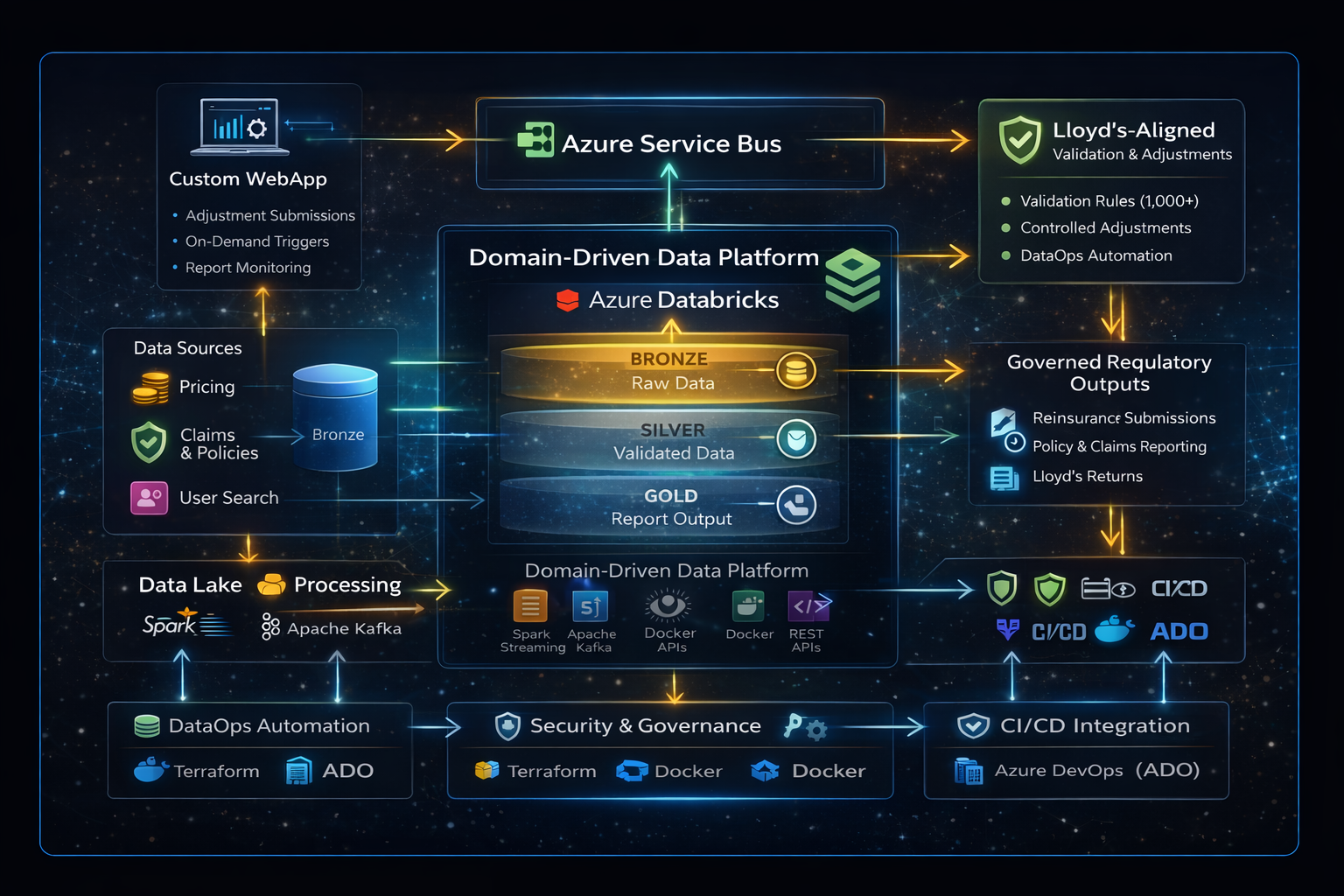
We designed and delivered a modern, domain-driven regulatory reporting platform on Azure, enabling fully automated, governed, and scalable production of Lloyd’s submissions in-house.
The solution was built on Azure Databricks and Azure Data Lake Storage (ADLS), following a modular, data product-oriented architecture aligned with long-term enterprise standards.
The solution was built on Azure Databricks and Azure Data Lake Storage (ADLS), following a modular, data product-oriented architecture aligned with long-term enterprise standards.
Domain-Driven Architecture
Implemented structured data domains across Finance, Policy, Claims, and Reinsurance, applying domain-driven and data product principles with Medallion-based layering, standardised conventions, and a security model aligned with the Principle of Least Privilege to ensure traceability and governance.
Metadata-driven Framework
Developed a reusable PySpark-based, metadata-driven framework to standardise transformation and validation logic, enabling scalable implementation of ~10,000 business metrics and 1,000 Lloyd’s validation rules with consistent engineering practices.
Regulatory Data Quality
Implemented a robust data quality framework incorporating approximately 1,000 automated validation rules aligned with Lloyd’s specifications, ensuring accuracy, completeness, and compliance across all regulatory submissions.
Engineering Standards
Established containerised local development, automated unit testing, linting, formatting standards, and integrated code quality controls to enforce homogeneous implementation, improve reliability, and ensure long-term maintainability across reporting pipelines.
DataOps automation
Implemented Infrastructure as Code using Terraform and CI/CD pipelines in Azure DevOps (ADO) to automate platform provisioning and controlled promotion of data products across dev, qas, uat, prod, and dre environments.
Web App RT Integration
Integrated Azure Databricks with a custom WebApp via Azure Service Bus to enable controlled execution of reporting pipelines. Users can apply manual adjustments and trigger reprocessing of Lloyd’s reports through an event-driven orchestration model.





The Value
The platform transitioned Lloyd’s regulatory reporting from an outsourced, manually coordinated process to a modern, domain-driven in-house data capability. By industrialising validation, version control, and governed adjustments, the organisation gained operational control, cost efficiency, and a scalable foundation for future financial reporting initiatives.

4
0
9
4
3
7
8
6
4
$
1M
4
3
2
7
8
0
4
2
0
Monthly Cost Reduction
Replaced third-party reporting services with an automated internal platform, generating significant recurring savings.
4
0
9
4
3
7
8
6
4
2
0
4
3
2
7
8
0
4
2
0
0
4
3
2
7
8
0
4
2
0
+
Regulatory Reports Industrialised
Delivered automated production of 200+ different controlled versions of 50 Lloyd’s submissions .
4
0
9
4
3
7
8
6
4
1
0
4
3
2
7
8
0
4
2
0
0
4
3
2
7
8
0
4
2
0
0
4
3
2
7
8
0
4
2
0
+
Automated Validation Rules
Embedded Lloyd’s-aligned validation controls to ensure accuracy, completeness, and regulatory compliance
.svg)
Internalised Regulatory Control
Transitioned Lloyd’s reporting from a third-party agency to an internally governed platform, increasing transparency over calculation logic, validation processes, version management, and audit traceability. The organisation gained direct ownership of regulatory production and reduced operational dependency on external providers.

Scalable Domain-Driven Data Foundation
Established a modern domain-driven architecture across Finance, Policy, Claims, and Reinsurance, creating a structured and reusable enterprise data foundation. The platform standardised engineering practices, governance controls, and data product principles, enabling future regulatory and financial reporting initiatives to be delivered more efficiently.
.svg)
Governed and Repeatable Compliance
Embedded automated validation rules, controlled adjustment mechanisms, and CI/CD-driven release processes to ensure consistent, production-grade regulatory submissions. The architecture enforced a security model aligned with the Principle of Least Privilege, strengthening compliance, access control, and operational risk management across environments.

Talk Less. Build More.
© 2026 All rights reserved