From Reactive Monitoring to Predictive Analytics in Banking
The Client
A large international banking group providing comprehensive retail and corporate financial services across multiple markets. The organisation operates an extensive network of branches, digital channels, and multichannel customer touchpoints, supported by complex core banking systems and distributed technology platforms.
Its service portfolio includes personal and business banking, lending, payments, treasury services, and investment solutions for individuals, SMEs, and large enterprises. With millions of customers and a substantial operational footprint, the institution manages high transaction volumes across a broad ecosystem of interconnected systems and channels.


The Challenge
The bank operated a highly distributed technology landscape composed of infrastructure components, application platforms, and business systems generating large volumes of operational data daily. Monitoring processes were largely manual, reactive, and updated periodically, limiting the ability to detect issues early or obtain a consolidated view of system behaviour across layers.
Operational visibility was fragmented. Infrastructure metrics, application logs, and business activity were analysed in isolation, preventing correlation across systems and channels. This made it difficult to identify root causes of incidents, anticipate service degradation, or understand how technical issues were impacting customer operations and branch performance.
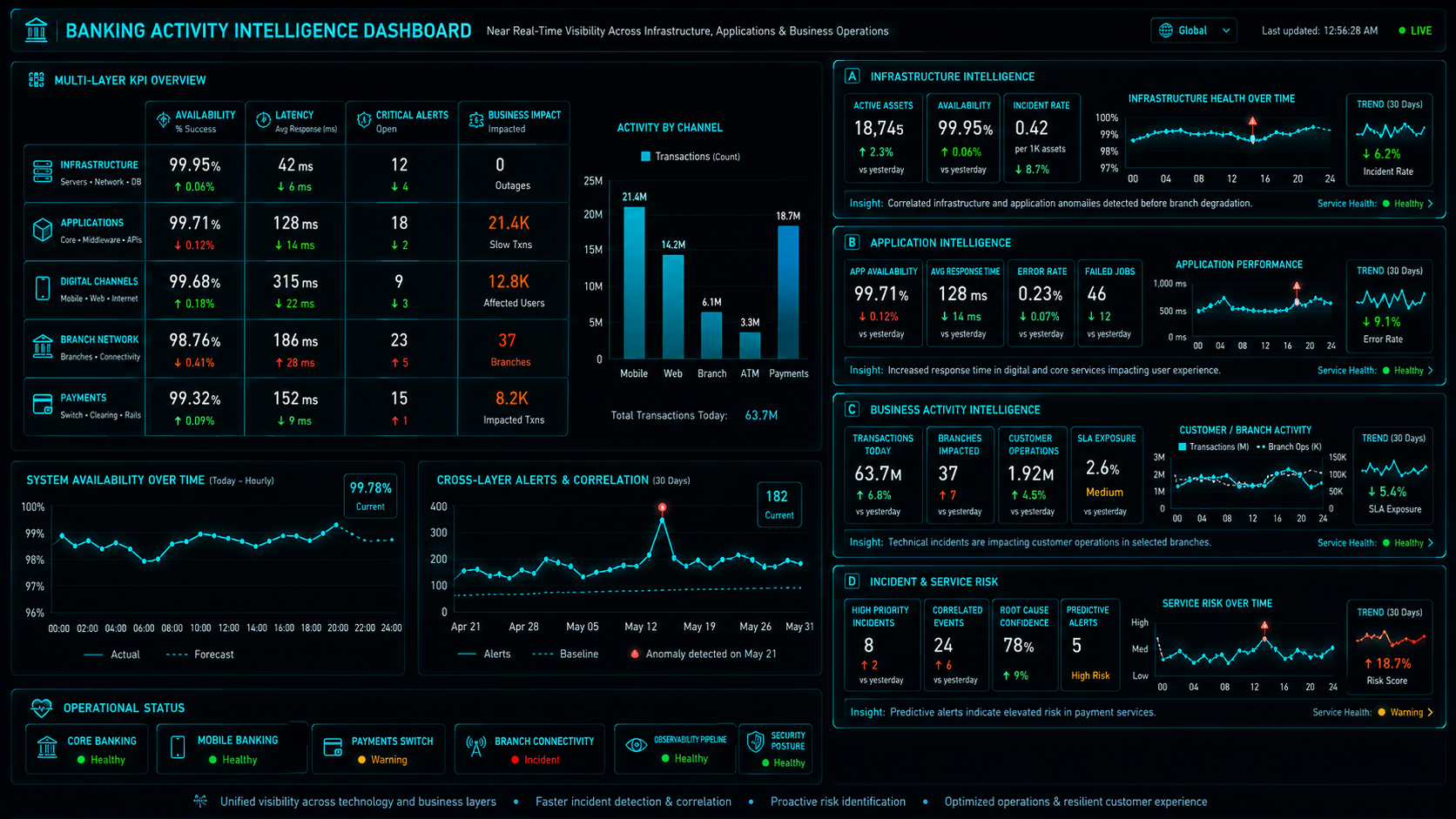
The institution needed to evolve from reactive monitoring to a near real-time, multi-layer activity intelligence capability—integrating infrastructure, application, and business signals to enable proactive incident management, operational optimisation, and predictive insight across its multichannel banking ecosystem.
Our Solution
The Value