From Outsourced Reporting to an In-House Lloyd's Regulatory Data Platform
The Client
A publicly listed global (re)insurance group headquartered in the United States, operating across property, casualty, and specialty lines. The organisation underwrites complex risks for multinational corporations and institutional clients, with a strong presence across North America, Bermuda, Europe, and Asia.
As a large-scale international carrier operating within the Lloyd's market, the company is subject to stringent regulatory and financial reporting requirements. Its global footprint, underwriting complexity, and capital management obligations demand high standards of governance, accuracy, and transparency across regulatory submissions.


The Challenge
Regulatory reporting to the Lloyd's market was historically outsourced to a third-party managing agency. While compliant, this operating model limited internal control, reduced transparency over calculation logic, and constrained the organisation's ability to evolve reporting processes in line with business and regulatory change.
The reporting landscape itself was complex and high-volume. Lloyd's submissions required the production of 50 distinct regulatory reports, each subject to frequent iteration and version control. The reporting logic incorporated approximately 10,000 business metrics and required strict adherence to 1,000 validation rules defined by Lloyd's specifications. Ensuring consistency, traceability, and auditability across this scale of reporting posed a significant architectural and operational challenge.
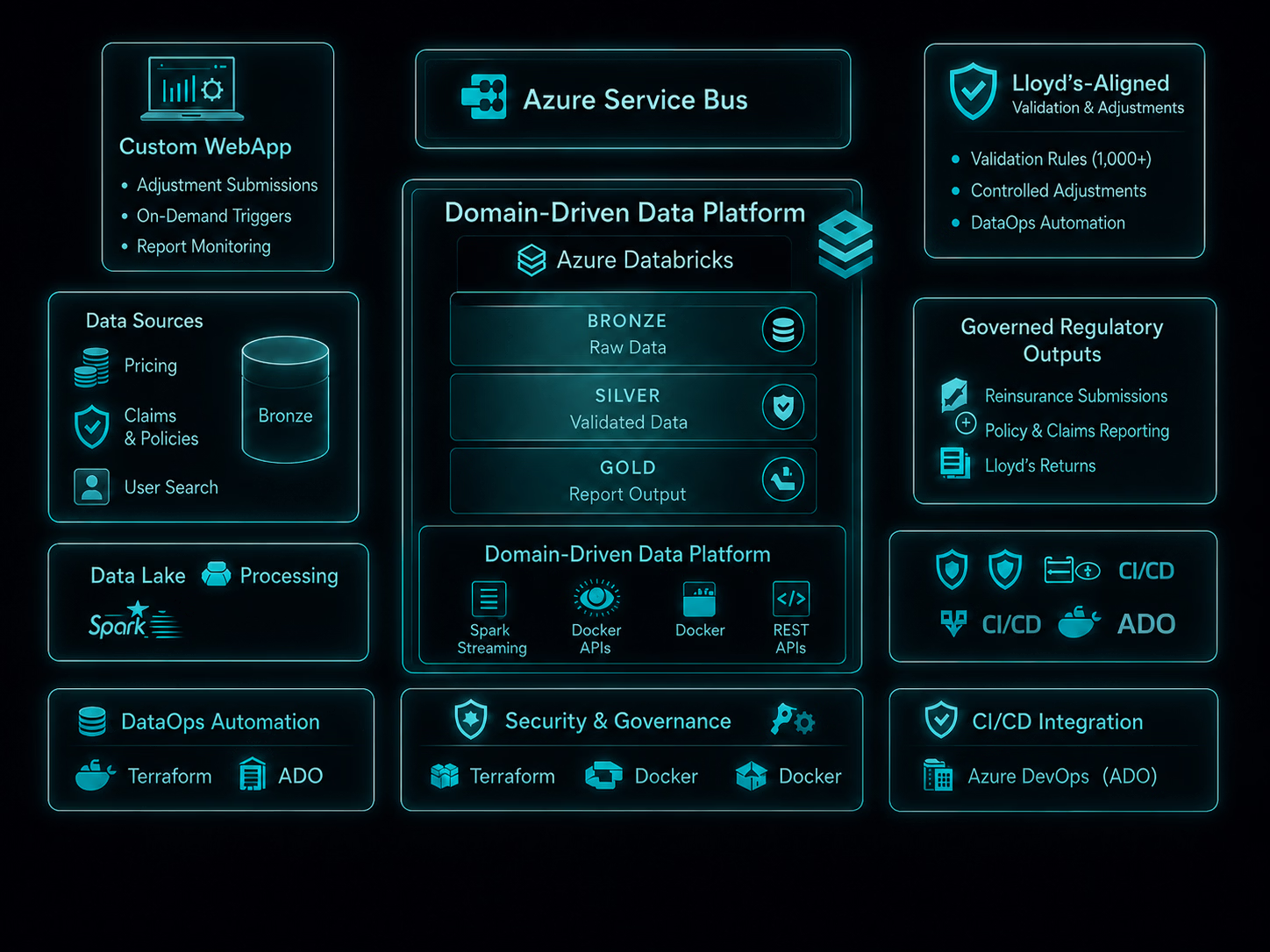
The organisation needed to transition from a manually coordinated, externally managed process to a modern, automated, and internally governed data platform capable of industrialising regulatory production. The objective was not only to internalise reporting, but to design a scalable domain-driven architecture that could support future financial and regulatory use cases beyond Lloyd's submissions.
Our Solution
The Value